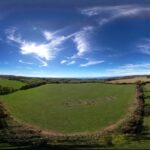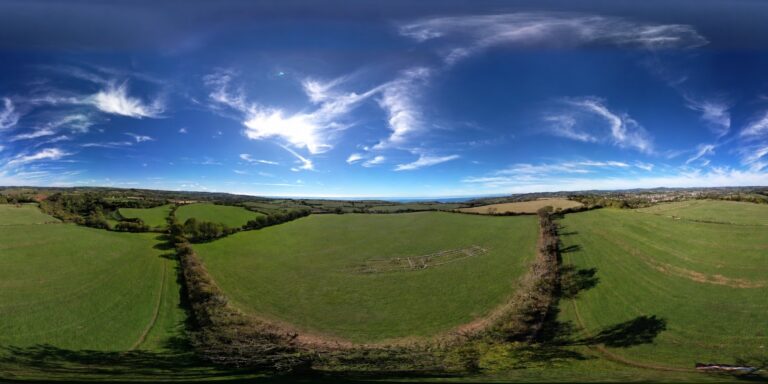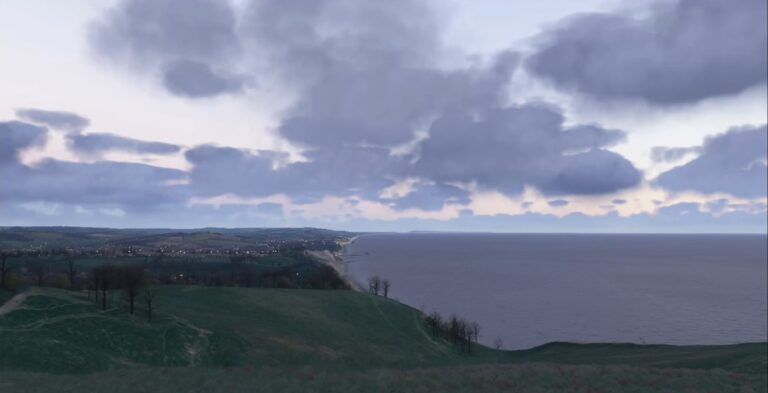

It looks just like a regular field these days but this is a view of the main field that Chisels, an Anglo-Romano villa settlement occupied certainly from the 2nd to the 4th century AD in the hills of West Dorset although I’d claim, (based on evidence including a chunky 1st century coin of Hadrian, that an earlier 1st century occupation may have taken the form of a military outpost at the bottom corner of the site, (bottom left in the main image), where that location would have offered a complete strategical view of the ocean before, later, a more traditional settlement manifest.
That said though, it was always extremely rare for such settlements to be located atop hills or on such high ground. (More about that elsewhere).
Talking of timelines, as far as military campaigns were concerned, the Romans had a reasonably easy time subjugating the tribes they encountered.
The Romans had brought luxury, exotic new materials, fashion, amazing technologies … along with fine wines and a sophisticated culture so many British tribes, (apart from the Durotrigian chieftains in our area), had ‘given in’ without putting up a fight soon after the 43AD invasion, (landing their fleets at Poole, mainly), simply because they recognised a good thing when it came knocking.
Thus, for the 300+ years the Romans occupied our shores, life was largely uneventful conflict-wise.
And, anyway, although we have called a time after the Romans left, the Dark Ages, thanks to incredible hoard finds and the latest research, we now know that the Celts of the time back then were incredibly sophisticated, prior and since the Roman occupation of their lands so, sure, I’m confident a ‘Romanised culture of Celts simply carried on their flavour of the Anglo-Romano culture gifted them by the experience even after that regime was no longer an influence..
And remember what I said about nobody living in the lowlands. Meaning, by the time the Romans had gone and society, (I’m guessing), was progressing in other ways, we have exactly the culture you and I were chatting about, (Re Ethelstan, 927AD, the first official King of England and with him came the Motte and bailey castles and such protection that the British people could now populate those lowlands and not just live in the naturally fortified places like Eggerdon or Pilsdon or Annotsbury hillforts.
About the Author