
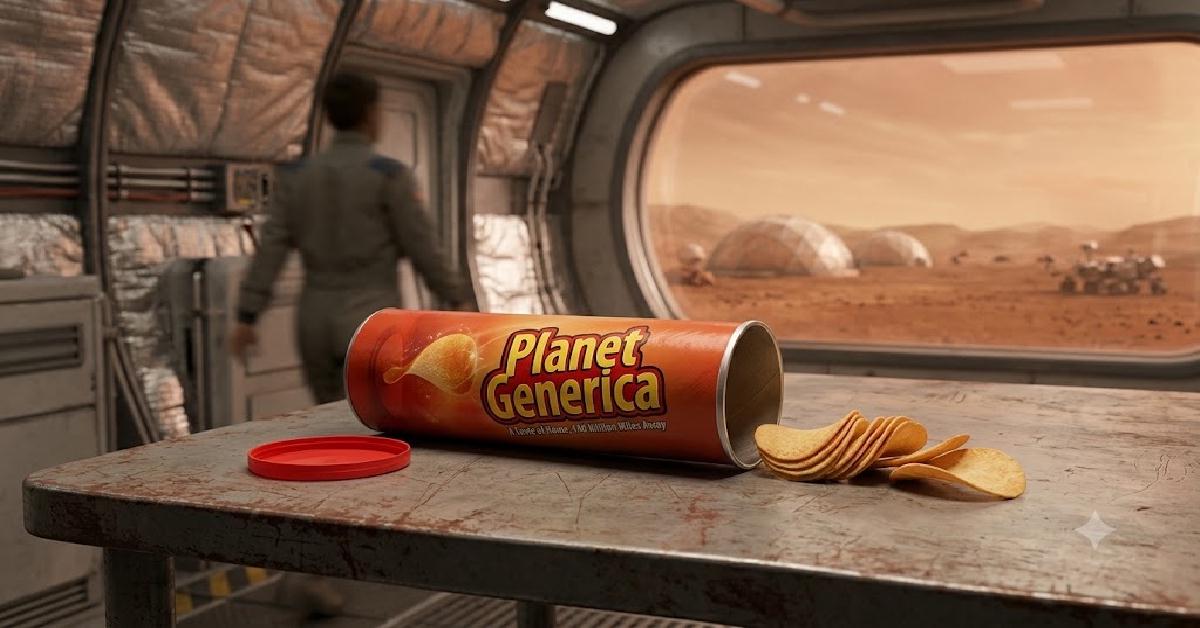
Planet Generica is my speculative framework for a world where nothing is ever truly discarded.
The concept of the idea has been with me 30+ years and orbits one particular mass produced product that has grinded my gears way way before even that time
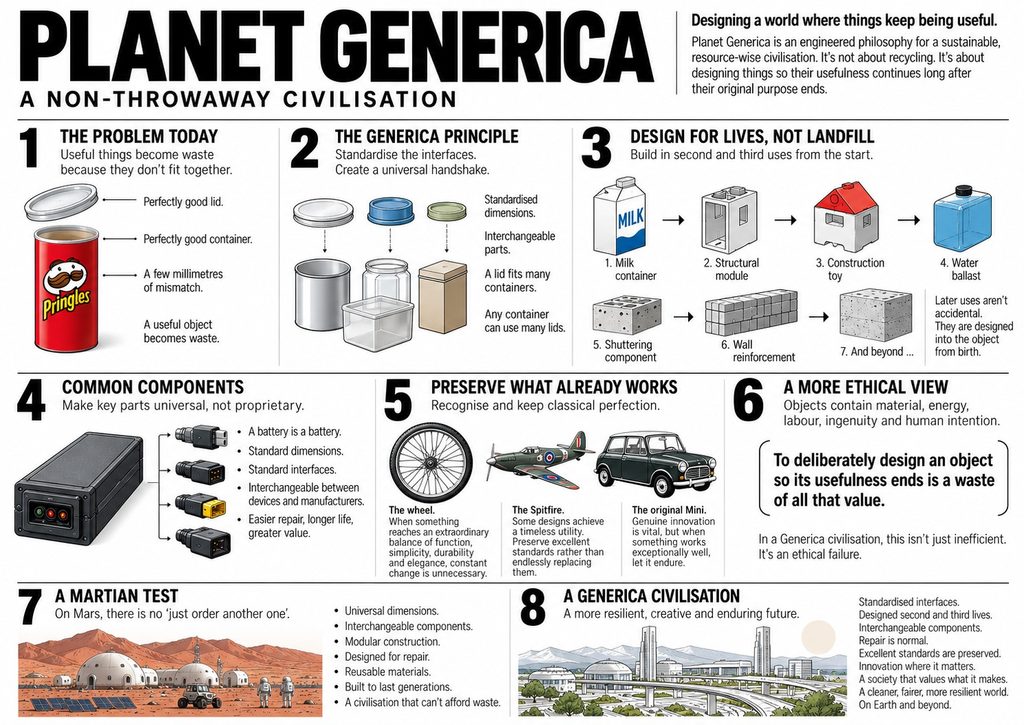
At its heart, Planet Generica is an engineered philosophy for creating a non-throwaway civilisation.
It is not, principally, about recycling. Recycling is almost a failure state in the Generica universe. The much more radical proposition is:
Don’t make things disposable in the first place. Design them so that their usefulness continues after their original purpose ends.
The governing principle is essentially mandatory second- and third-life design. Objects would be designed, and potentially legally required, to have useful subsequent purposes rather than becoming waste when their first job is finished.
1. The “Smidgeon” problem
The deceptively profound starting point is the Pringles lid.
A Pringles lid is potentially useful as a lid. A tin is potentially useful as a container. Yet a tiny dimensional mismatch means the two objects cannot cooperate.
That tiny mismatch represents something much bigger in Generica:
the arbitrary gap.
Manufactured things should share dimensional standards wherever practical, creating a Universal Handshake.
A lid should fit another container.
A battery should fit another machine.
A connector should connect.
A structural component should mate with another structural component.
So “Generica” does not mean bland or homogenised.
It means generic at the interface.
That distinction is fundamental.
2. The milk carton is probably the clearest Generica object
The square milk container is almost a miniature manifesto.
It starts life as packaging.
But instead of:
milk → empty carton → bin/recycling
the Generica sequence becomes something like:
milk → structural module → children’s construction toy → water ballast → shuttering component → wall reinforcement → something else
The important part is that the later uses aren’t accidental.
They were designed into the object from birth.
That is why “second-life design” actually undersells what is being described.
It is closer to pre-programmed material continuity.
The object carries its future usefulness within its geometry.
3. Batteries expose the same problem at industrial scale
The laptop/e-bike battery illustrates the same principle at the technological level.
Today, a perfectly serviceable battery can become effectively useless because its plastic housing, mounting points, electrical interface or dimensions are proprietary.
Generica says:
Enough.
Make the battery a defined physical standard.
Then a battery isn’t a Samsung battery, a Bosch battery, a Gtech battery or a Beach battery.
It is simply a battery of Standard X.
The same logic applies to lamps, switches, fittings, connectors, motors and countless other components.
A component should remain useful because it is compatible with the wider ecosystem, rather than becoming redundant because its manufacturer has changed a casing, connector or dimension.
4. Classical Perfection
Planet Generica is not anti-innovation.
Invention, innovation, iteration and refinement are essential to human progress.
But there is a distinction.
Sometimes humanity produces something which has reached an extraordinary equilibrium of:
function, simplicity, durability, usability and elegance.
Examples include the wheel, the Spitfire and the original Mini.
Once something reaches that state, continuing to change it merely because “new” sells better can destroy the very qualities that made it successful.
This is Classical Perfection or Timeless Utility.
The wheel does not need a new marketing department every five years.
It just works.
The same principle can apply to a genuinely excellent standardised component. Once perfected, the standard itself becomes something worth preserving.
5. Waste therefore becomes an ethical question
The objection is not merely:
“Throwing this away is environmentally inefficient.”
It is closer to:
Something containing material, energy, labour, ingenuity and human intention has acquired value. Why should we deliberately design its usefulness to terminate?
Planet Generica treats the physical world as something with continuing potential rather than a succession of disposable consumption events.
This is a Philosophy to Do Good.
That explains why the word “crime” can appear in the original formulation.
It does not mean a police force chasing people who put a milk carton in the bin.
It expresses the deeper idea that a civilisation capable of designing objects to become useless has made an ethical choice about material value.
6. And then there is Mars
This is where the whole proposition becomes much less whimsical.
On Earth, wasting a useful component is stupid.
On Mars, it could be catastrophic.
A Martian civilisation cannot sensibly operate on the assumption that:
“We’ll just order another one.”
There is no convenient warehouse full of millions of replacement components down the road.
Martian infrastructure would therefore inherently favour:
- universal dimensions
- interchangeable components
- modular construction
- repairability
- reusable materials
- standardised interfaces
- replaceable rather than discarded assemblies
- gravity/geometry-based fixing systems
- components designed for several generations of use
Mars is therefore not a separate idea.
Mars is the ultimate stress test for Planet Generica.
Earth can afford absurdity because Earth is enormously rich in accessible resources.
Mars cannot.
7. From philosophy to physical infrastructure
Planet Generica is not intended to remain an abstract manifesto.
The proposition is simple:
Take proprietary technology, introduce a common interface, and return control to the owner.
A battery that belongs only to one machine becomes a battery that belongs to an ecosystem.
A connector that exists only for one product becomes a universal interface.
A fixing system becomes reusable infrastructure rather than something that has to be destroyed to replace what sits on top of it.
This is the transition from philosophy to physical infrastructure.
About the Author