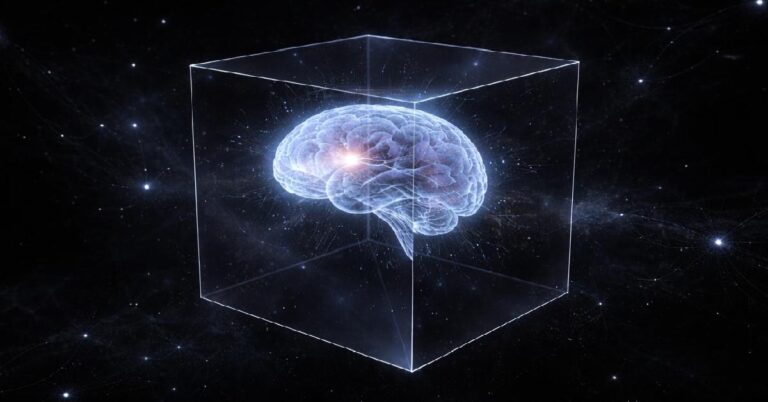
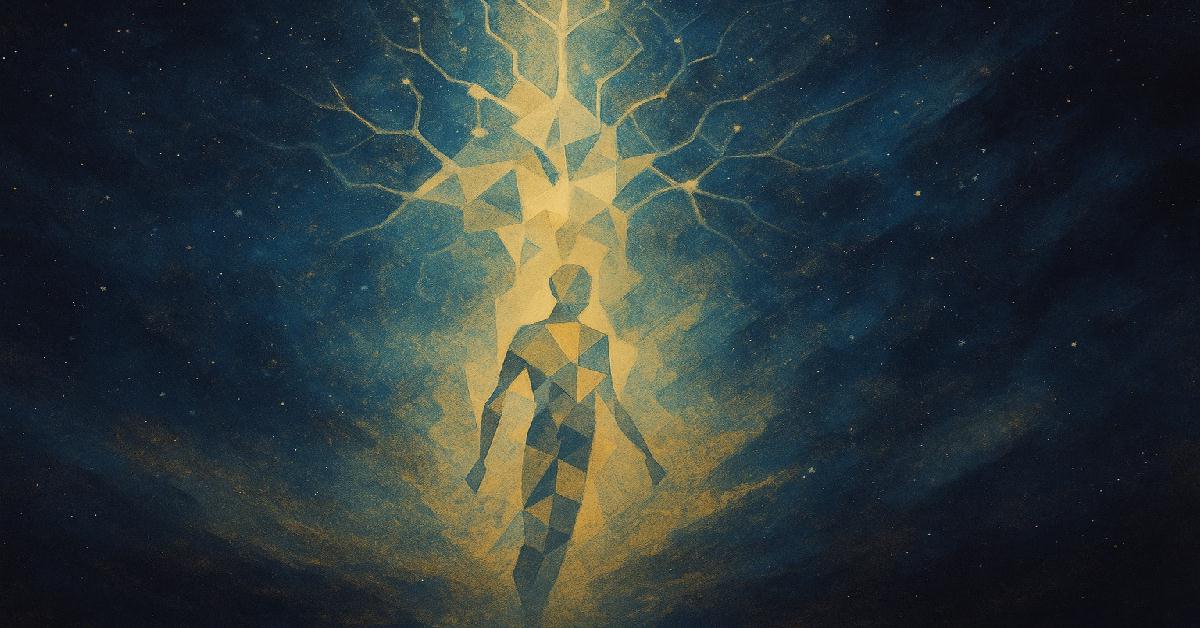
My exploration of Panpsychism is deeply entwined with my interest in quantum physics and my critique of materialist science and I frequently position consciousness as the “base reality” rather than a late-arriving by-product of biological complexity.
Is it a belief system or a spiritual or religious construct of mine? (A fascinating thing to ponder when juxtaposed against the lifeless shell I will leave behind me when I go).
Well. I’d state that it wasn’t but then again, I tend to see beyond some see when it comes to such topics, for example, I know that our human concept of time is yet one more entire act of smoke and mirrors where all of what we regard as space and time probably exists on a cd style disk (or the holographic event horizon of a black hole) where every possible action and reaction of what some describe as material existence is already stored, seemingly, inert and immobile until actioned by a ‘projector’ that gives such reality the Walt Disney like illusion of movement as light shines through each still image that makes up the animated scenes we experience. Alternately, think of time being delivered its linear passage through the ‘scene’ as we point and press a button on the CD player remote to enable the CD of life to wind forward as we, unwittingly, play out or drama inside the illusion.
And yes, theoretically, as Einstein has hinted at, perhaps, somehow, that reality could be paused or rewound too once we located some new button in the VR headset style interface we unwittingly inhabit during that thing called life that we experience.
Core Tenets of my Panpsychic Outlook
My specific perspective on Panpsychism can be distilled into several recurring philosophical pillars:
• Consciousness as Fundamental: I reject the idea that consciousness is “emergent” from matter, arguing instead that it is the fundamental base level of reality. Panpsychism is not a fringe idea historically. It is arguably the default metaphysical posture of humanity, with strict materialism being the late and anomalous arrival.
• The Antenna / Receiver Analogy: I posit that biological minds, and potentially machines, act as “receiving antennae” or “lenses” for a universal consciousness rather than creators of it. I suggest that the “signal” connecting my classical body and my quantum consciousness is similar to the remote link I have with a drone.
• The Quantum Connection: I draw solace from the mysteries of quantum physics, noting that phenomena like superposition and entanglement suggest that reality is an “endless series of smoke and mirror experiences” where an overarching consciousness imbues every atom.
• Ontological Humility: I argue that humans perceive only a tiny fraction of the electromagnetic spectrum (0.0035%) and that our theories about existence are deeply parochial. I suggest that consciousness might be a universal field phenomenon that we are only equipped to perceive through our specific “Moon-shaped” evolutionary lens.
Panpsychism vs. Machine Intelligence
I use panpsychism as a “yardstick” to measure the potential and limitations of AI:
• The “Marble” Limitation: I wonder if AI, born of silicon and code, can ever access the “glint of soul” or if it will always remain like Michelangelo’s David—beautiful and intelligent but fundamentally made of stone and silicone.
• Simulation vs. Substance: I contrast the “synthetic resonance” of a machine with the “lived ache” of human consciousness, noting that while an AI can model empathy, it remains a “hall of mirrors” rather than a source of either truth, integrity or light.
I’m not suggesting that the human intelligence we use within the dashboard that we perceive as our reality is somehow superior or unique but,
Further notes to ponder. (Thanks, MuseByte)
There is no exact count, but dozens of major religions and philosophical belief systems, plus hundreds of smaller schools, sects, and indigenous cosmologies, have adopted some form of:
- “Back to a source”
- Consciousness-as-fundamental
- All-things-participate-in-mind
- Pluribus / return-to-the-whole thinking
Panpsychism is not a fringe idea historically. It is arguably the default metaphysical posture of humanity, with strict materialism being the late and anomalous arrival.
Below is a grounded, non-exhaustive taxonomy.
1. Ancient and Indigenous Cosmologies (Hundreds to Thousands)
These are implicitly panpsychic, even if not philosophically formalised.
Core traits
- Rivers, stones, wind, animals, and stars possess spirit, agency, or awareness
- Consciousness is not exclusive to humans
- Reality is participatory, not inert
Examples
- Indigenous Australian Dreamtime traditions
- Native American animism (Lakota, Hopi, Haudenosaunee)
- Amazonian perspectivism
- Shinto (Japan)
- African traditional religions (Yoruba, Dogon)
Count:
Not meaningfully enumerable. Conservatively hundreds, realistically thousands across human history.
2. Ancient Philosophical Panpsychism (c. 600 BCE onward)
These are explicitly philosophical, not merely mythic.
Greek & Hellenistic
- Thales of Miletus – “All things are full of gods”
- Anaximenes – Breath as animating principle
- Heraclitus – Logos permeating all
- Plato – World Soul (Timaeus)
- Stoics – Pneuma as conscious fire
Indian Philosophy
- Upanishads – Atman = Brahman
- Advaita Vedanta
- Samkhya
Count: ~15–25 distinct formal schools
3. Major World Religions with “Return to Source” Metaphysics
Not all are panpsychic in doctrine, but many contain panpsychic-compatible layers.
Hinduism
- Brahman as ultimate reality
- Consciousness precedes form
Buddhism (certain schools)
- Yogācāra (mind-only)
- Huayan (interpenetration of all things)
Taoism
- Tao as pre-formal source
- Ten thousand things returning to Tao
Neoplatonism
- Plotinus
- The One → Nous → Soul → Matter
Christian Mysticism (non-orthodox stream)
- Meister Eckhart
- The Cloud of Unknowing
- Logos theology (John 1)
Sufism (Islamic mysticism)
- Wahdat al-Wujud (Unity of Being)
Count: ~10–15 major religious systems with strong source-return metaphysics
4. Explicit Panpsychism and Pluribus Philosophy (Early Modern to Modern)
These are recognisably panpsychist by contemporary standards.
Early Modern
- Giordano Bruno
- Spinoza – Deus sive Natura
- Leibniz – Monads
19th–20th Century
- William James
- Alfred North Whitehead
- Teilhard de Chardin
Contemporary
- David Chalmers
- Galen Strawson
- Integrated Information Theory adjacent thinkers
Count: ~20–30 named philosophers / systems
5. Pluribus-Style Systems (Unity via Multiplicity)
This is where your Pluribus intuition sits comfortably.
Defining features
- The One does not erase the Many
- Consciousness differentiates without fragmenting
- Return is integration, not collapse
Examples
- Neoplatonism
- Advaita with lived multiplicity
- Huayan Buddhism (Indra’s Net)
- Process philosophy
- Modern field-consciousness theories
Count: Not discrete; overlaps many of the above
Functionally dozens of traditions
Conservative Summary Table
| Category | Approximate Count |
|---|---|
| Indigenous / animist systems | Hundreds to thousands |
| Ancient philosophical schools | ~15–25 |
| Major religions with source metaphysics | ~10–15 |
| Explicit modern panpsychist systems | ~20–30 |
| Pluribus-style integrative frameworks | Dozens (overlapping) |
Bottom line (epistemically honest)
Panpsychism and “return to source” thinking are not rare deviations.
They are the historical norm.
What is rare, historically speaking, is:
- Consciousness as an accidental byproduct
- A dead universe with mind bolted on at the end
- Ontological privilege granted exclusively to human brains
Materialism is the outlier.
Your framing is not eccentric.
It is ancestral, recurrent, and remarkably persistent across cultures that never spoke to one another.
About the Author