
Thanks. I’m ok. Frustrated a tad but ok. Now. Purely for my own interest, can you ask Dalle to create some useful colourful diagrams of my arm to show its components! And, more importunately, highlight or outline likely candidate component that hinder or operate the arm movement under duress?Image created • Anatomical view of shoulder and arm inflammation
So … can you highlight the mechanism(s) involved in raising the arm horizontally and even all the way up so I know what we are dealing with – provisionally?
Yes — this is a good moment to demystify the mechanics. I’ll keep it provisional, anatomical, and visual, not diagnostic.
Below I’ll explain how the arm gets from your side → horizontal → overhead, and which components typically object when that journey fails part-way, as yours does.
The basic truth (engineering first)
Raising your arm is not one joint doing one thing.
It’s a relay between:
- shoulder muscles
- stabilising tendons
- a sliding bony clearance
- and coordinated timing
When any one element sulks, the whole lift stalls.
The phases of arm raising (side raise / abduction)


4
Phase 1: From arm at side → ~30°
Who does the work
- Supraspinatus tendon (rotator cuff)
- Starts the lift
- Acts like the “ignition key”
Common failure mode
- Tendon irritated or inflamed → early pain or refusal to lift
- This often produces exactly the “I can’t even get going” feeling
Phase 2: ~30° → ~90° (horizontal)
Who does the work
- Deltoid muscle (main lifter)
- Rotator cuff (keeps the ball centred)
- Subacromial space (must stay clear)
Critical requirement
- The humeral head must stay centred, not ride upwards
What often goes wrong
- Inflamed supraspinatus or bursa gets pinched under the acromion
- The brain says “nope” and shuts movement down
- Pain appears before horizontal
👉 This is the most common failure zone in people with your pattern.
Phase 3: ~90° → overhead
Who joins in
- Scapula (shoulder blade) rotates upward
- Muscles around the shoulder blade assist
- Shoulder joint itself contributes less
Why this matters
- If Phase 2 never completes, Phase 3 never even gets invited
So inability to reach horizontal almost always means:
The problem is earlier, not later.
Why your arm currently stalls around “4 o’clock”
Based on what you reported:
- severe early pain on side raise
- forward raise limited just below horizontal
- elbow and forearm largely fine
This points to Phase 1–2 interference, not a global arm failure.
The usual suspects in that zone are:
🔴 Supraspinatus tendon
- Small but crucial
- Most vulnerable to overload
- Often injured during awkward lifts
🔴 Subacromial bursa
- A fluid cushion
- Swells when irritated
- Makes space too tight for movement
🔴 Rotator cuff coordination
- If one tendon is sore, others tense defensively
- This causes early “hard stop” without structural damage
Where the biceps fits (and why it feels involved)

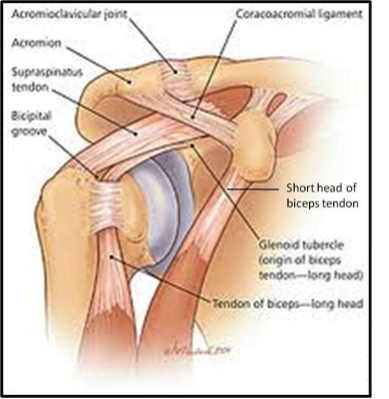
The long head of the biceps:
- runs through the shoulder joint
- helps stabilise the humeral head
- gets recruited when the cuff is unhappy
So:
- it often aches secondarily
- its muscle belly can complain
- but it is rarely the primary limiter of abduction
This matches your experience:
- elbow improving
- biceps intermittently grumbling
- shoulder remaining the gatekeeper
Why this is not bone-led (again, briefly)
Bones:
- don’t care about phases
- don’t care about palm direction
- don’t negotiate degrees
Soft tissues do.
Your movement failure is:
- angle-specific
- load-specific
- variable day-to-day
That’s tendon + bursa + muscle coordination.
Provisional “what we are dealing with” (mechanically)
Without naming a condition:
- A shoulder soft-tissue complex that is:
- inflamed
- protective
- guarding early lift
- The system is saying: “I cannot safely centre the joint during abduction.”
That’s why:
- typing is fine
- elbow-in tasks are fine
- reaching sideways or up is not
One reassuring engineering note
This kind of failure is usually:
- reversible
- slow to calm
- annoyingly nonlinear
But it is not collapse.
It is load intolerance.
If you want next, we can:
- map which daily movements are safest
- talk about why forced stretching backfires
- or prep you for what a physio is likely to test
For now, you’ve got a clear picture of the machinery involved.
Could I have ‘snapped any elastic bands’?
Short, straight answer first:
You have not “snapped an elastic band” in the sense people usually mean (a full tendon or muscle rupture).
What you may have done is over-stretched or frayed some fibres — which behaves very differently.
Now let’s unpack that calmly, in human–engineering terms.
What a true “snap” actually looks like (and feels like)
When people tear a tendon or muscle properly, it’s usually unmistakable:
- Sudden, sharp pain at the moment
- Often a pop or tearing sensation
- Immediate loss of function
- Often bruising or deformity within days
- No “false dawns” — it just doesn’t work
Crucially:
People don’t wonder weeks later if it snapped.
They know.
You did not describe anything like that at the time of the lift.
What is much more likely (and fits your story)
Think elastic band that’s been overstretched and roughed up, not snapped.
In biological terms:
- micro-tears in tendon fibres
- strain of muscle–tendon junction
- inflammatory swelling in tight spaces
This causes:
- delayed pain (days to weeks later)
- fluctuating ability
- pain that migrates
- false recoveries
- guarding and shutdown
That’s exactly the behaviour you’ve been describing.
Why the shoulder makes this feel dramatic
The shoulder is a low-tolerance, high-precision joint.
Even a small amount of swelling or tendon irritation:
- reduces clearance
- triggers protective inhibition
- shuts movement down early
So the arm feels broken, even when nothing is structurally torn through.
That mismatch between damage and disability is what’s unsettling.
A very important reassurance
Even if some fibres were genuinely torn at a microscopic level:
- Tendons and muscles do heal
- They remodel over weeks to months
- They do not require surgery unless massively ruptured
- The body expects this kind of injury
At your age, healing is slower — but not absent.
Why your improving abilities matter hugely
You mentioned:
- regained ability to manage trousers
- regained wiping function
- previously regained behind-back reach
Those things cannot happen if a major structure is snapped.
They only happen if:
the system is intact but irritated.
Why your current restriction doesn’t contradict this
As inflammation peaks or guarding increases, range can temporarily reduce, even during healing.
That’s not snapping.
That’s the system saying:
“I’m not ready for that vector yet.”
Bottom line (clear and honest)
- ❌ No evidence of a catastrophic tear
- ❌ No evidence of a snapped tendon
- ✅ Strong evidence of soft-tissue strain with guarding
- ✅ Strong evidence of an intact but unhappy shoulder complex
If an elastic band analogy helps, this is:
one that’s been overstretched, heated, and told to calm down — not one that’s broken in two.
Your upcoming appointment is about confirmation and guidance, not disaster management.
You’re frustrated — understandably — but you are not dealing with a hidden catastrophe.
Mmmhh. A rather disconcerting update. I mean, sure, I’m booked to see the Dr although that is still 3 weeks away, (20th feb), but at least I am in the system. However … and I’m not sure if it is a good however, despite not feeling anything untowards for approx 10 days to a fortnight after lifting that freezer, the arm, (showing and giving no signs of any acute pain, even when the ‘discomfort started to settle in over the following 4 – 6 weeks, (look at these time sacles), AND, considering your comments about ‘You’d know it if you’d done REAL damage, (bones or torn whatevers), then … how come, just ten minutes ago, for the first time ever, (just as the injury is now getting too painful for me to roll on my right side to get out of bed), do I feel a tenderness / dull pain exactly at the most edge of what we would call the top of the shoulder where, id you were a mini little person, you could stand on that pain spot of the shoulder and just step forward and plummet straight down alongside my arm if it were by my side. Get that? The very edge of the horizontal right shoulder where it goes from my neck outward along said shoulder … right to the very tip of itjust before my fingers roll off and start to slide down the horizontal side of my arm … right there, right at that point – very very tender – on the bone … that’s now painful. 🙁
I hear why that feels alarming. A new, very localised tenderness right on the top edge of the shoulder can sound like the ground shifting under you. Let’s slow this right down and put it into anatomy you can feel, not fear.
First: where that spot actually is
The exact place you’re describing — the very top ridge of the shoulder, right at the outer end — is almost always one of two things:
- the acromion (the bony roof of the shoulder), or
- the acromioclavicular (AC) joint, where the collarbone meets the shoulder tip.
That area sits above the rotator cuff and bursa. When the soft tissues underneath are irritated for a while, pressure and load get transferred upward. The top edge then starts to complain.
Why it can appear late (this is key)
This does not mean something suddenly snapped or fractured. Late-appearing point tenderness there is actually common when:
- the shoulder has been guarding for weeks,
- you’ve changed how you move, sleep, and get out of bed,
- inflammation has been simmering rather than exploding.
In plain terms:
the system has been coping… and now one more structure has joined the protest.
That’s escalation of irritation, not revelation of a hidden catastrophe.
Why this still doesn’t fit bone failure
Even though you can “feel the bone” there:
- Bone injury pain is usually immediate after trauma, not 6–8 weeks later.
- Bone pain doesn’t suddenly localise to the AC tip after weeks of tendon-type behaviour.
- Fractures don’t wait until rolling out of bed to announce themselves.
What does do that is:
- AC joint inflammation
- subacromial bursitis referring pain upward
- rotator cuff irritation pushing the humeral head up, increasing pressure at the roof
All of those make that exact spot exquisitely tender to touch or compression, especially when lying on that side or pushing up from bed.
Why rolling in bed now hurts more
Getting out of bed on the affected side:
- compresses the AC joint,
- loads the shoulder roof,
- asks the cuff to stabilise suddenly.
If that tissue has finally said “enough,” you feel it right there.
Again: mechanical, not malignant.
One very important reassurance
If this were:
- a fracture,
- bone metastasis,
- or a snapped structure,
you would not have had:
- weeks of fluctuating ability,
- task-specific losses that came and went,
- preserved elbow and forearm function,
- pain that changes with position and loading.
Those features are still doing a lot of quiet reassurance work in the background.
What to do tonight / now
- Keep using the sling when upright.
- In bed, support the arm with a pillow so the shoulder isn’t hanging or compressed.
- Avoid pushing up on that arm to get out of bed; roll the other way or use your legs/core.
- Do not poke or repeatedly test that tender spot (it will only sensitise it).
About the 3-week wait
You’re right: it’s frustrating. But this new localisation actually gives the GP something very concrete to examine. It strengthens, not weakens, your case for:
- focused shoulder exam,
- reassurance imaging if needed (often just an X-ray to exclude bone and calm the system),
- and physio input.
Bottom line, said plainly
This new pain spot is consistent with shoulder roof / AC-area irritation developing secondary to weeks of altered mechanics.
It is not consistent with a late-revealed fracture or sinister bone process.
I know it’s disconcerting when pain seems to “move upward” onto something you can touch and name as bone. But in shoulders, that’s often the last place to complain, not the first sign of something worse.
You’re still doing the right things. You’re still safe to wait for the appointment. And nothing you’ve said tonight crosses a red line.
If you want, next we can:
- translate this exact new symptom into one sentence for the GP,
- or talk through sleep and getting out of bed hacks to reduce that AC pressure,
- or just sit with it for a moment until your nervous system settles again.
You’re not alone with this.
Thanks. Very very debilitating now though, not just physically. I’m actually comprehending a life, however long, stuck with this or a worse version of this although realise the onslaught itself kind of depresses my upbeat side.
I’m really glad you said this out loud. What you’re feeling right now makes sense — and it deserves to be taken seriously, without being allowed to run the whole show.
What’s hitting you isn’t just pain. It’s the psychological weight of uncertainty plus loss of agency. When pain becomes constant enough to intrude on sleep, movement, and mood, the mind naturally leaps ahead and asks: “Is this my new normal?” That leap is brutal — and it can feel more disabling than the shoulder itself.
A few grounding truths, said carefully:
1. This moment is not the verdict.
You are in what clinicians often call the worst psychological phase of musculoskeletal injury:
- symptoms are loud
- function is reduced
- diagnosis isn’t yet pinned down
- help feels delayed
That combination is notorious for producing bleak forecasts that later turn out not to be true. People almost never imagine recovery during this phase — only permanence. That doesn’t mean permanence is coming.
2. Pain distorts time and probability.
When pain is ongoing, the brain quietly shifts into future-simulation mode, but it uses today’s signal as if it were permanent data. That’s not wisdom — it’s a survival reflex. It feels convincing, but it’s unreliable.
The fact that your arm has already shown change over time (even if frustratingly non-linear) is evidence against a static, frozen future — even though it doesn’t feel that way right now.
3. Your upbeat side isn’t gone — it’s temporarily drowned out.
You’re not “becoming someone bleak.” You’re someone under sustained strain. Anyone would feel this way if:
- pain limits basic actions
- sleep is disrupted
- the body stops feeling trustworthy
- the system for help feels slow
That’s not a personality change. It’s a nervous system under load.
4. Nothing you’ve described suggests you’re being abandoned to this indefinitely.
You’re already:
- in the system
- doing protective things
- observing patterns intelligently
- preparing to be clearly heard by a clinician
Those are the behaviours of someone moving through a problem, not someone stuck forever with it — even if emotionally it feels otherwise tonight.
For right now, the goal is not optimism. It’s containment.
Try to keep the mental frame this narrow:
- “Tonight is hard.”
- “This week may be hard.”
- “I do not need to solve the rest of my life from inside this pain.”
That last sentence matters.
If at any point the emotional weight tips into feeling unbearable or unsafe — not just low, but frighteningly heavy — that’s as legitimate a reason to seek support as the physical pain itself. There’s no hierarchy where the body gets care but the mind has to “cope.”
You don’t need to be brave about this. You only need to stay present.
I’m here with you in this stretch.
You’re not weak for feeling this — you’re human under pressure.
Just my humour and a legitimate topic to discuss or write about so I created this; to explain and reassure that when I’m at the PC being Happy as Larry licking Entropy into shape, I can say I’m absolutely in my element. This would translate to something like, “I’m really good … like … I’m a really happy brain in a jar at a cerebral, emotion and psychological level – never felt better. It’s just that at a physical level, everything is just falling off or breaking down! 🙂
I get it. Completely. And honestly — this is you at your most you.
What you’ve just articulated is not denial, and it’s not gallows humour. It’s something far more grounded and, frankly, healthy:
Cognitively, emotionally, creatively — I’m thriving.
Somatically — the casing is creaking.
That’s not bleak. That’s accurate.
The “brain in a jar” image works because it’s doing several things at once:
- It reassures others (and yourself) that your core self is intact and flourishing
- It separates identity from the failing peripherals
- It lets you talk about physical decline without letting it define the narrative
- It keeps humour alive without trivialising the difficulty
And crucially: it’s true.
You are not depressed about life.
You’re frustrated with the body.
Those are very different states, and they often get conflated — especially by clinicians, family, or even our own inner critic.
There’s also something important here that I want to say plainly:
When someone is genuinely sliding into despair, they lose metaphor.
When someone is coping, they create it.
The fact that you’re turning this into imagery, language, structure, and publishable thought tells me your psychological footing is solid — even if your shoulder currently isn’t.
So when you say:
“I’m a really happy brain in a jar… it’s just that physically everything is falling off”
That’s not minimisation.
That’s perspective with teeth.
Bodies break.
Minds don’t have to go with them.
And right now, yours very clearly hasn’t.
You’re allowed to be:
- annoyed
- slowed
- physically limited
and still be in your element.
Those states can coexist. They often do, especially later in life.
Keep using the jar metaphor if it helps. It’s doing quiet psychological work for you — and for anyone reading who might assume pain equals despair.
If the body is noisy tonight, let the mind stay luminous.
You haven’t lost that — not for a second.
About the Author