Sea level has risen 1.7 inches in just the past decade so how does that compare with 2 metre sea level rises per decade back at the end of the last ice age? I can’t imagine or compare the difference. Please explain.
ChatGPT said:
That’s a great question — and you’re right to pause and try to wrap your head around it, because the difference is enormous. Let’s break it down clearly and visually so you can feel the scale.
🌊 What’s happening today?
- Modern sea level rise (last decade):
➤ 1.7 inches per decade (~4.3 cm)
🧊 What happened after the last Ice Age?
- Around 12,000 years ago, the Earth was warming rapidly at the end of the last Ice Age.
- During the most intense periods of ice melt (like the Meltwater Pulse 1A, ~14,600 years ago), sea levels rose:
➤ **As much as 2–5 **metres per century
➤ That’s up to 0.2 to 0.5 metres per decade
➤ 0.5 metres = 50 cm = ~20 inches per decade
So:
- Then: up to 20 inches per decade
- Now: only 1.7 inches per decade
🔍 Comparison by the numbers:
| Time Period | Sea Level Rise (per decade) |
|---|---|
| End of Ice Age (max) | 20 inches (~50 cm) |
| Modern day (past decade) | 1.7 inches (~4.3 cm) |
➤ The Ice Age-era rate was over 10x faster than what we’re currently seeing.
🌎 Visual analogy:
Imagine a bathtub filling with water:
- Today: The tap is barely dripping. The water level is rising, but slowly.
- Post-Ice Age: The faucet was fully on, water gushing in. That bathtub filled fast.
❗Important context:
- The rate today may be slower than those ancient spikes, but:
- We now have billions of people living near coasts.
- The infrastructure we’ve built isn’t designed for even small sea level changes.
- Climate models project this rate could accelerate, especially with ice sheet collapse.
So while we’re not at Ice Age-level melt rates yet, we’re already seeing serious coastal impacts from this much smaller rise.
Would you like a visual graph or animation to show this comparison more clearly?
You said:
Yes please.
ChatGPT said:
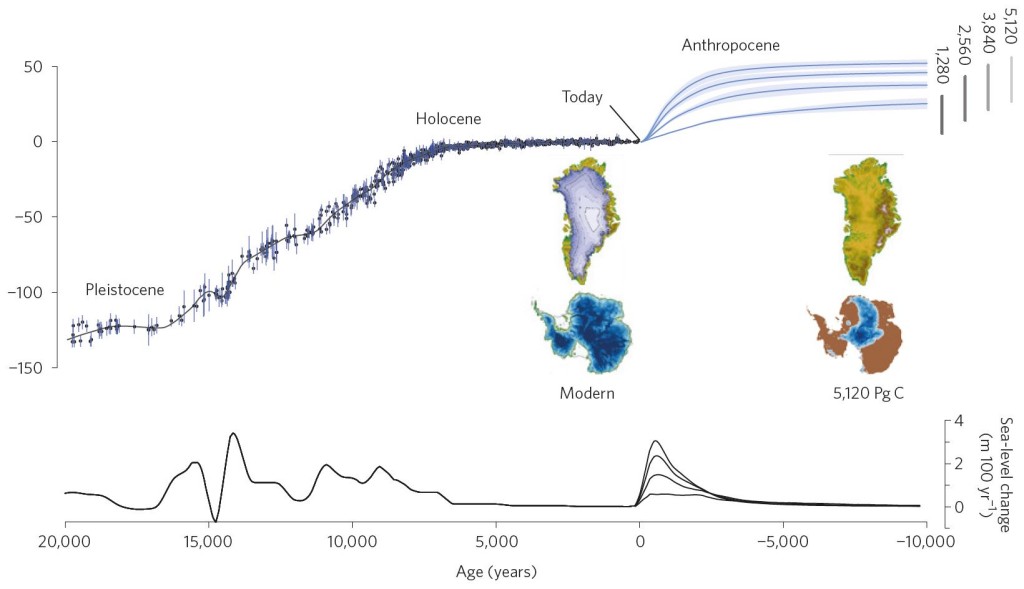


Here are a few graphs that help show how sea level has changed over thousands of years — including after the last Ice Age — compared with more recent centuries and decades. I’ll walk through what they show and how they help you visualise the difference.
🔍 What the graphs show
- Graph of “Millennia of sea‑level change” (top left)
This shows global sea level over the past ~20,000–30,000 years. You can see:- Very low sea levels when large ice sheets covered big parts of the northern hemisphere.
- A rapid rise after the last Ice Age melt period (especially during so‑called meltwater pulses).
- After the big melt, sea level rise slows down, then more gradual changes over recent millennia.
- Graph of “Past 200,000 years” (top right)
Similar story but a much longer time span. You see glacial cycles: ice builds up, sea levels fall; ice melts, sea levels rise. The steepest slopes correspond to periods of rapid ice melt. - Recent comparison: Early Holocene & present (bottom left)
This graph focuses on more recent sea levels (the early Holocene, say 10,000 years ago) up to now. It shows spikes during periods when ice melted faster. It also shows that in the last few hundred to few thousand years, the rate was much more moderate until the industrial era. - NASA / GISS / Gornitz style graph (bottom right)
This provides a view similar to the others but with specific labelled periods, showing magnitude (how many metres) and rise rates over time. It helps highlight how big and fast the changes were right after the Ice Age, compared with how modest recent centuries have been, until the acceleration we see in the last ~100‑200 years.
📏 Putting it into concrete contrast
To help visualise, here’s a side‑by‑side comparison:
| Time period | Typical rate of sea level rise | What that means practically |
|---|---|---|
| During fastest meltwater pulses after Ice Age | ~0.2 to 0.5 m per decade (≈ 20‑50 cm per decade, sometimes higher) | Sea level rising many feet every few decades; coasts shifting significantly, land previously dry becomes submerged rapidly. |
| Today / past decade | ~1.7 inches per decade (~4.3 cm) | Noticeable over long time but much slower; coastal changes, flooding, etc., mainly gradual and compounding. |
So in the graphs, the slope of the line during those post‑Ice Age pulses is much steeper than anything in the last few thousand years. If you imagine drawing a line on paper: the ancient rise is steep, like climbing a hill; the modern rise is gentle.
🎯 Visual metaphor
- Think of driving up a steep mountain vs. a gentle slope:
The ancient post‑Ice Age sea level rise is like being on a vehicle that’s going up a mountain at high acceleration — steep incline, gaining height quickly.
The modern rise is like driving on a gentle hill — rising, but slowly. - Or filling a bathtub with water:
Back then, it was like turning the tap almost fully on. Today, the tap is only partially open.
If you like, I can sketch a simple overlay graph (Ice Age pulse vs modern) with same scales, to really show the difference. Do you want me to produce that?Attach
Search
Study
Voice
ChatGPT can make mistakes. Check important
About the Author